Showing posts with label sand. Show all posts

Friday, March 22, 2013

Universally Accessible Nature Themed Play Area

It was a cool March morning, but the sand and water area at Harper's Playground was packed! Kids were sliding down all sides of the 'grassy' hill. From a distance the play area looked peaceful and really fun. My daughter ran for it across the lawn.

Harper's Playground - Portland Oregon

" Harper’s Playground will build community by providing an inclusive playground at Arbor Lodge Park where children and adults of all abilities can play together."
- The Harper's Playground Mission


The playground is beautiful and well laid out. Every feature is accessible or has an accessible type. An artificial turf grass surfacing was used in some of the use zones. I thought it would look pretty fake. But, with all the action of the kids and other design features it melted to the background really well. There are lots of different types of play (including just exploring and running around, which seems to be ever popular). The central mound with the slide is a really great feature. It adds topography and interest to the overall design.


What a beautiful asset for this City of Portland Park. Project Partners included Place Studios, Walsh Construction and lots of other donors.


Friday, February 15, 2013

Water Channels

A Month of German Inspiration

This hand pump and water channel were by far the most popular event in this very busy schoolyard. You can see the boulder water channel that continues into the playground. I am not sure what the vision was, but when we were there the water never got further then 20 feet from the pump. This left the serpentine boulder 'creek bed' dry. In the end I think it was more of an obstruction to running and chasing in the rest of the play area.

Wednesday, November 14, 2012

Nature Play At Home

I share a lot of ideas and projects on the blog that are related to public projects and sites that are open for all types of users. In no way was this meant to say that nature play needs to be done on a large scale. Quite on the contrary, many parts of nature play have to do with materials, textures and small details.

There are some really easy places to start offering nature connection at home

Offer Natural Materials:  

Let kids collect these materials while on a hike then explore them more at home. Relate them to the seasons and seasonal patterns. There is so much to be learned from breaking open a fall nut or smelling a spring flower.


from: http://progressiveearlychildhoodeducation.blogspot.com/


Offer Sand and Water Access:

Again it can be simple. Below is a fire pit turned into sand and water exploration. This works great because it comes with a mesh top covering to protect from animals and leaf litter.


Offer a Mud Kitchen or Potions Lab:

There is nothing better then a mud pie with fresh spices and flowers from the garden. Round up a few old kitchen containers and tools and identify a 'work counter'. Kitchen and potions labs help young children master the use of kitchen tools in a creative, no worries way. They are often not as much of a mess as you would expect. :)


from: http://rhythmofthehome.com/2010/05/mud-pie-kitchen/


Offer Real Tools to Interact with Outdoors:

Kids are naturally drawn to simple household tasks and tools. These small repetitive movements help with coordination as well as muscle memory and brain development.


A Great Resource for Further Exploration:

The Natural Wildlife Federation has recently Publish this resource, "Make your Backyard the Best Playground - Naturally!" It is jam packed with ideas and resources.


Enjoy!

Tuesday, October 23, 2012

Nature Play Inspiration : School Grounds and Wood


Natural Playground Construction Timelapse from Turtle Rock Preschool on Vimeo.


I find these photos very inspiring. Their use of wood and natural materials is beautiful and in nice proportions.  The resulting spaces, most of which are in schools, would be inspiring and trans formative for young people. I have seen a few climbers similar to this, but this one is massive and has beautiful lines. All of these pieces were designed by Copper Beach in the UK. Their website has many more photos and information on their projects.


Friday, August 17, 2012

Case Studies for Natural Play Areas in Oregon

The Oregon Natural Play Initiative has been working on putting together case studies for some of the natural play areas in the state. There are a few dozen examples on the website. They include photos as well as interviews with owners, maintenance risk and play area users. It is a great way to see some examples and also lessons learned. As part of the initiative I completed some of these interviews and learned a lot in the process. Take a look and let us know what you think.


Do you want to add an Oregon project that we missed? Just let me know.

Monday, June 18, 2012

Nature Play Toolkit


GreenWorks recently created this nature play tool kit for Portland Parks and Recreation while working on the Westmoreland Park nature play area. It outlines some of the main activities, materials and concerns in nature play areas. It is a bit of a graphic menu for nature play design. These are a few pages from the draft version for review and comment.

On a schematic level these images help explain nature play to public and maintenance audiences. It can help garner support for a project or help bring everyone onto the same page. While it is many steps away from a design that is complete, safety reviewed and ready for play, I think it is an inspiring start.

What do you think? How would this toolkit be useful to you or your organization?


Tuesday, June 12, 2012

Nature Play in Parks: Two New Oregon Examples

Tualatin Hills Parks and Recreation District (THPRD) has opened two fantastic new nature play areas. One is an Off-trail Play Area and the other is a Natural Playscape. These play area types are defined further in my previous post on THPRD's Nature play guidelines.

Hyland Forest Park:
This piece of forest is set aside and free play is allowed. Fort building, exploration, digging and other activities are all allowed. It is part of a free play pilot project in the parks district.


The entire area is delineated by these signs, maybe every 30'.


There are lots of fots already built and ready to add on to!

There are more delicate built items like the 'soup bowl'

Camille Park:
This is also in the THPRD park system, but it is a very different park. They consider this one a natural playscape. It is a mix of natural themed equipment and natural materials.

Walking up onto the play area it is almost hard to tell it is a play area!

the more traditional equipment area

The awesome log stack!

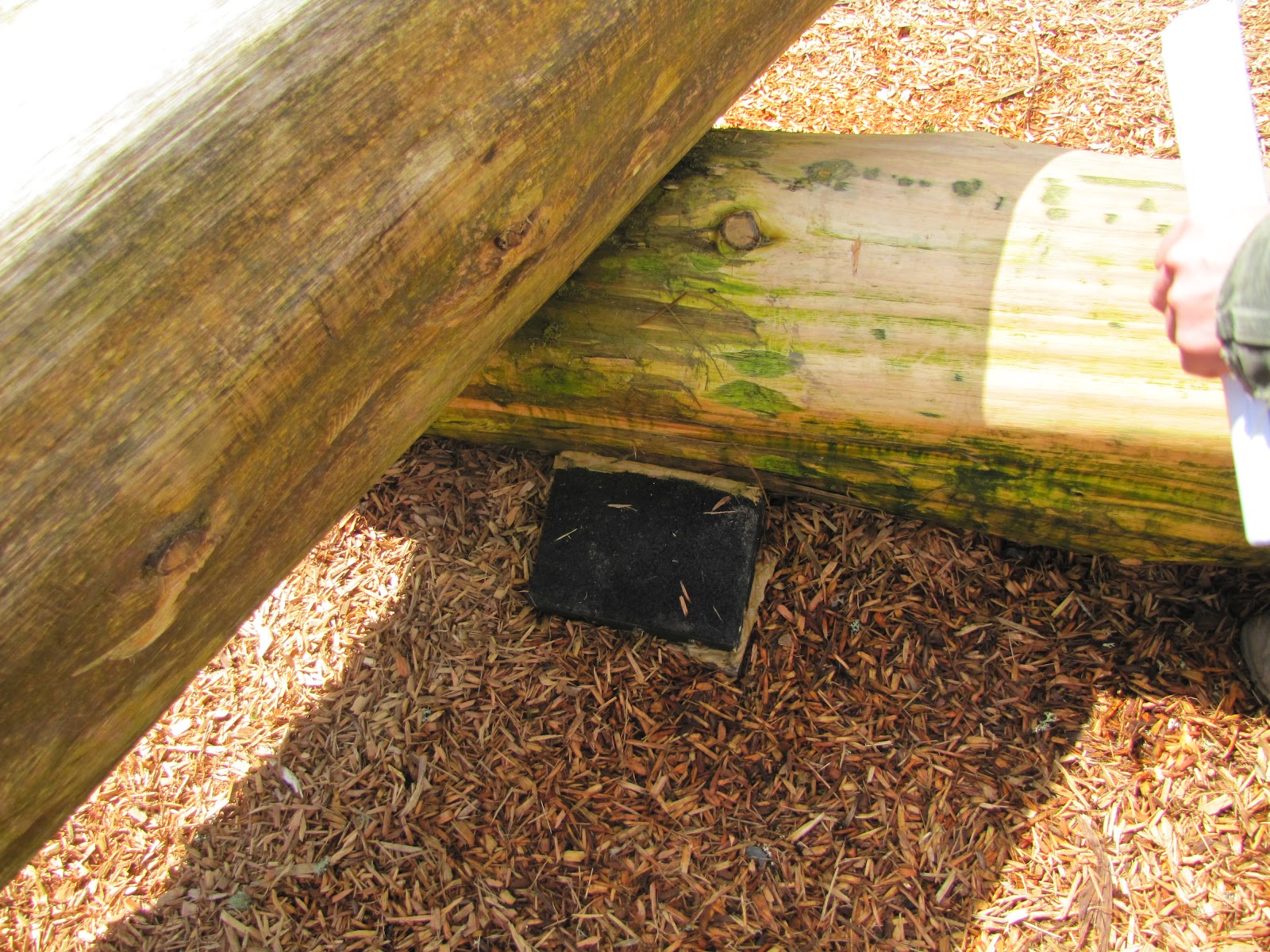
Logs are set on concrete footings and rebar adds support so they wont move around.
But these logs are huge! I can't image they will move for a long time.

Another view that I think is peaceful and beautiful especially compared to what a colorful climbing set would look like.

sand play

Thursday, June 07, 2012

Natural Play in Montessori Settings

I have been looking for a Montessori program for my little one and at the same time doing some landscape improvements at our house that will facilitate play. While she is a bit young for a slide or climbing equipment there are lots of things that are montessori based that she can do now. To me Montessori spaces are inviting in nature: they are inspiring, organized, and calm.

http://www.arborday.org
MARIA MONTESSORI
One of the central tenants of the Montessori philosophy is the connection with the natural world. Children should have the daily opportunity to experience the outdoors with structure and purpose. She placed a great emphasis on nature and nature education. Dr. Montessori also felt that the outdoor environment should be an extension of the classroom.


http://naturalplaygrounds.com

“It is also necessary for his psychical development to place the soul of the child in contact with creation, in order that he may lay up for himself treasure from the directly educating forces of living nature.” Maria Montessori


FACILITATING MONTESSORI WORK
Many of the ideas are not space based they are 'work' based. Much of Montessori education is based on prepared tasks or work that children can practice and achieve. How can Montessori work be adapted to outdoor spaces and materials? As a designer this leads to what types of spaces are needed? What materials are offered, where are they stored, and how?

Here is a basic Montessori math activity. We need exactly 55 pine cones (children check their work by using all the pieces) usually stored in a nice basket, chalk (also in the basket), a large, flat, and safe space where they can write and organize without being interrupted.


from http://livingmontessorinow.com
ORGANIZATION AND MATERIALS
Materials and spaces need to be organised so appropriate work can happen and so children are drawn to the work.


from http://progressiveearlychildhoodeducation.blogspot.com

APPROPRIATE OUTDOOR WORK
Much of the Montessori work for little ones happens around practical life skills. If only we can get kids to weed! At least digging, wheelbarrows, sweeping and planting seem to be within reach.


I could not find this web sourfce again after catching these littel ones at work. Please let me know if you know the source.


How do we inspire a deep and true connection to nature? I like this Montessori farm approach (dispite being bit by a chicken as a child)!

www.mountainlaurelmontessori.org

HOW TO MAINTAIN THE OUTDOOR MONTESSORI AREA
The process from inspiration to design can be a long and detailed endevour.  But, there are some wonderful resources out there. The Montessori Print Shop has learning materials as well as a specific section on playgrounds. They have a lot of helpful playground forms including an injury log, inspection forms for daily, monthly and yearly and seasonal maintenance. While the forms may seem like extra work they will be invaluable for maintenance, extending the life of your playscape, protecting children and liability.


Monday, April 30, 2012

Jungle Playgrounds

Wow! These are amazing play spaces! I love the simple materials, variety of spaces and challenge they offer. Both of these 'jungle play' spaces are outside the US. Maybe one day we could get one for Oregon kids!


This film says it was made in 1987 and the jungle playground  from the model is built and in daily use. (Soon with english subtitles)


I have a few worries about this type of play in our litigous American society. The first is about the fall zones or "use zones". These films show a lot of trees being used as supports for the ropes and trees have roots. Not so great to fall on. The second is the ropes. They look like they are just tied on to posts and trees. Hopefully someone is keeping a close eye on them to inspect for slipping, rot, and loose knots.

Besides a few initial worries, I think these play areas are fantastic. Watching the kids jump from one to the other, swing and jump to another piece or letting go while upside down, they are developing great motor skills and look to be having a great time doing it. Another wonderful benefit is the csot of these play areas has to be more managable for a school, small  community center or neighborhood.

Sunday, March 18, 2012

Nature Play Community Workshop

In Portland we celebrated St. Patrick's Day with a community design event for a nature play area that will be built in Westmoreland Park. I could not have anticipated how much the kids were going to enjoy the event. Their creativity, teamwork and ingenuity were all in full gear. It was an amazing start to an exciting project.


The Concept:
Portland Parks and Recreation and GreenWorks Landscape Architecture invited the community to play with natural materials, talk about natural play, make models and lay the groundwork for the upcoming design at the Westmoreland Park. The City of Portland recognizes the benefits of letting children play in nature; including physical, mental and social benefits. At a Parks and Recreation staff workshop earlier this week risk, maintenance and criteria for natural play were discussed.


The Activities:
Activities ranged from having adults remember their childhood play experiences, to free building and water play areas, to model making stations. The design team was able to talk with kids and adults about what they would like to see in the natural play area.


The Outcome:
We had fun! I think everyone enjoyed themselves. The kids were amazing. Nothing had to be explained, they just arrived and dove in. Kids of different ages and abilities were working together, creativity soared, and we got amazing feedback and ideas for the play area.


Related Posts Plugin for WordPress, Blogger...