Showing posts with label schools. Show all posts

Wednesday, May 08, 2013

Learning Landscapes Start a New Design Shop

Hi Readers

I am excited to announce that Learning Landscapes has turned from a blog into a business! After many years of thinking and researching about inspiring children's spaces I have taken the leap to owning and running a business. With 6 projects underway the business is off to a great start.

I will continue to blog, but the interface will look a little different. Updates will come from the new websitehttp://www.learninglandscapesdesign.com/ It will also have updated sections on the company, current projects, and how we could help you realize your project. 


I welcome your comments and ideas and hope you continue to enjoy the blog.

Michelle

Friday, March 29, 2013

Removing Asphalt to Build a Natural Playground

It seems that playgrounds consisting of a sea of asphalt with a few pieces of playground equipment off to the side have been the norm for a long time. Some of us think that it has been the norm for too long!
We want to see this...

turn to this...
Mt. Hood Community College Early Childhood Center

Removing asphalt can be a tricky project and I have found a few reoccurring issues that should be addressed. If you can jump through a few hoops it can be one of the most rewarding projects for your school or playground. 


1 Parking
Make sure you maintain the amount of parking required by code (In Portland OR check here). Although you may not want to use the parking spaces. There is often a minimum amount of spaces required. If you have to keep the spaces in the long run, but don't need them for the current building use consider some creative building on top of the asphalt.

Marylhurst Early Childhood Center in Oregon City - under 'construction'.  They segmented off part of the unused parking area for play by using planters and biobags.

2 Soil Tests
It is always a good idea to test the soil under the asphalt. Depave a Portland Organization specializing in pavement removal says,
"Depave discourages community members from removing pavement that is covering contaminated soil. If contamination is currently present in the soil, the contamination is capped and is not causing any severe negative environmental or health impacts. Unless there is a cleanup plan in place, removing the pavement may do more harm than good." 
This is great advice especially when kids, gardening, or water are involved. Depave has more advice in their how to depave guide.


3 Water and Traffic Flow
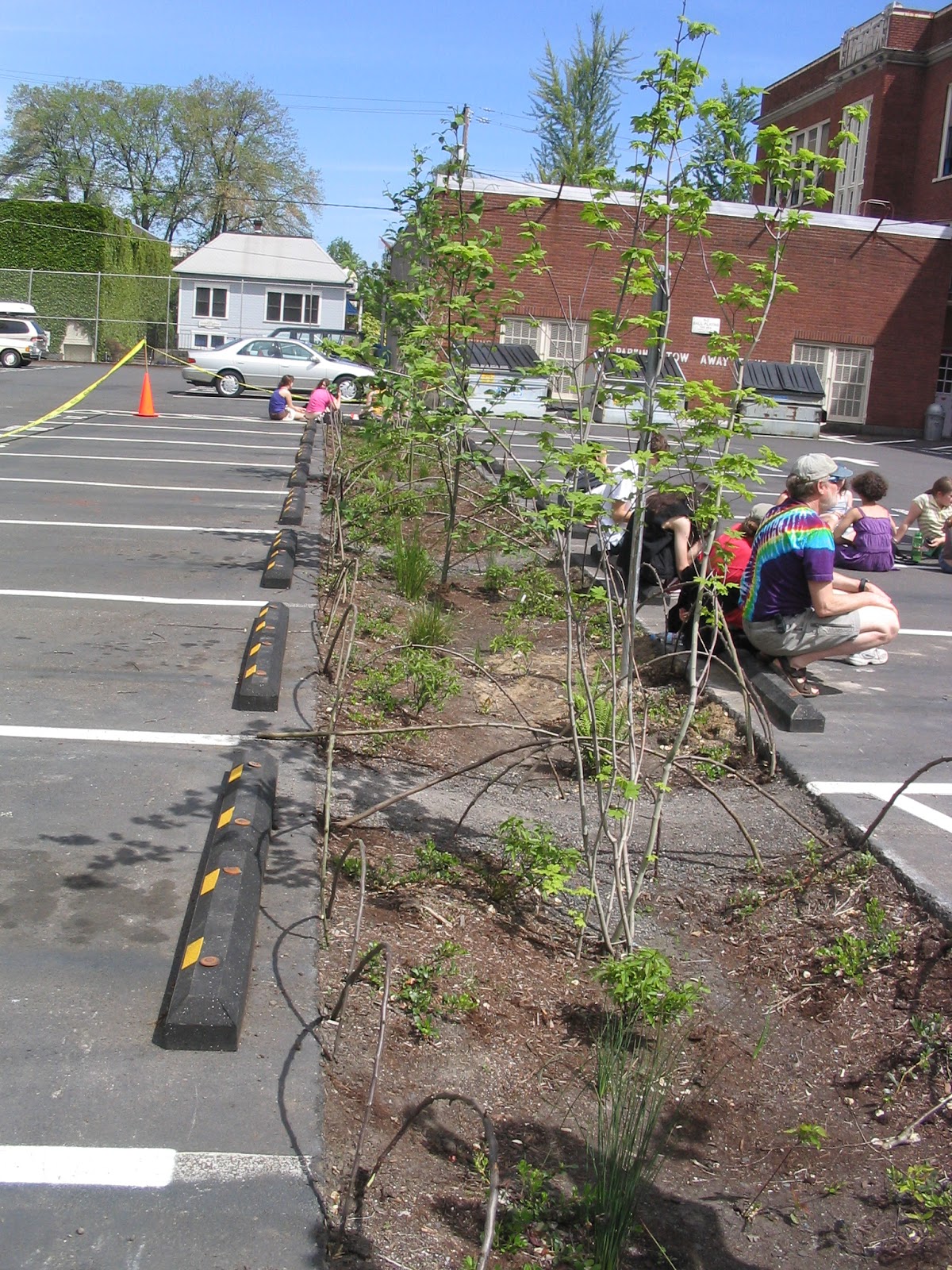
Take a good look at your site and make sure the asphalt removal is not going to trigger any new problems. Asphalt conveys water well from one area to another, soil and play areas may erode under the same water forces. Is there anything draining to the asphalt? Where will the water go once the asphalt is removed? This is a great opportunity to incorporate stormwater features and rain gardens.

Also consider traffic. How will people get around in the new area? What effects will this have on the new uses of the space?

Rainwater Feature at Mount Hood Community College Early Childhood Center.
 It takes water from the roof top to a playground stormwater swale.

4 Create a New Vision Plan
Develop a site plan that outlines what you will do after the asphalt is removed. Remember that under the asphalt is often 4" to 6" of rock on top of very compacted soils. Plan to help bring your soils back to life through aeration and added nutrients.

Create a Concept Plan for the new area that includes all of the proposed elements to scale


5 Removal and Disposal

Always call before you dig! Running into an underground line can be a very big danger. Asphalt is also softer and lighter than concrete and is not suitable for reuse. It is readily recycled by pavement processing companies. It is not something you want to bury on your site. the National Asphalt Pavement Association has further information and resources.


6 Implement Your New Design

Now the fun can start! I would love to see your success stories of children's spaces built after asphalt removal.


Wednesday, March 13, 2013

National Wildlife Week

The National Wildlife Federation is celebrating National Wildlife Week with some great information about animals and how they depend on trees. There is a 6' tall poster, trading cards on animals and trees as well as free trees for students to plant. These are great resources to jump start a conversation with the young people in your life. Enjoy!


Monday, February 18, 2013

The Five Way Tire Swing

A Month of German Inspiration


This is one of the mist engaging pieces I saw in Germany. (Completely against the ASTM safety rules in the US.) This 5 sided wood pole swing structure lets kids swing toward one another and makes for a very dynamic and social swinging experience.


Sunday, February 17, 2013

A Month of German Inspiration


Introducing the bug hotel, built by high school students to house bugs near their garden. It is also beautiful and artistic.

Friday, February 15, 2013

Water Channels

A Month of German Inspiration

This hand pump and water channel were by far the most popular event in this very busy schoolyard. You can see the boulder water channel that continues into the playground. I am not sure what the vision was, but when we were there the water never got further then 20 feet from the pump. This left the serpentine boulder 'creek bed' dry. In the end I think it was more of an obstruction to running and chasing in the rest of the play area.

Thursday, February 14, 2013

Little Forts: In, On and Around

A Month of German Inspiration


There are so many types of little forts, houses and play buildings. Kids use every inch (and side) of these spaces. At this school the roofs were getting just as much use at the inside. Remember this when you decide what is surrounding your fort or house. Make the spaces safe for climbing, jumping and falling.

Thursday, January 17, 2013

Stormwater at Schools


It is the middle of winter and stormwater is on our minds here in Portland. It is a topic most kids are drawn to. What little kid can resist a puddle? We have a fabulous opportunity to teach with stormwater at our schools. It is visible, occurs all winter long and can be quite beautiful.

Collecting Stormwater at Schools
Schools often have large surrounding sites. In Portland they are one of the largest urban land holders. That means lots of rain and lots of roof to capture rain. Plenty of our schools have lots of asphalt too. The wonderful thing about working at the school is students can help throughout the entire process. See some of my favorites below.

Bridge Water Garden Before
At Bridge School not only was asphalt pavement removed, but stormwater from the roof was diverted into the water garden.

Bridge Water Garden After
http://www.pps.k12.or.us/schools/bridger/208.htm
Safety Hurdles
Safety is always a top concern at schools. Some of the ways you can avoid the unwanted combination of kids and water (or kids and mud) are
- locate the stormwater facility away from the high traffic areas liek the playground or main door. Place it somewhere there is a watchful eye; outside the office or classroom.
- Design it to have a maximum level of water that is still very shallow
- Avoid steep slopes
- Don't try to hold the water in a container and release it later, especially if kids will come in contact with it. You start to get into sanity issues.

Examples
Portland Public Schools has a great stormwater website with photos of their school stormwater facilities. Below are some of my favorite projects. The best projects,

GET THE KIDS INVOLVED!


Fernwood MS Students Installing Their Swale

Fernwood MS Downspout Disconnect and Swale

*********************


Harvey Scott Students Forming Their Swale

Harvey Scott School Swale and Outdoor Classroom

*********************
Maintenance at DaVinci Middle School

Da Vinvi Middle School Rain Garden

*********************
Metropolitan Learning Center
Students picking water loving plants

Metropolitan Leaning Center Swale-
Kindergarden kids compacting the soil on the edges.
Metropolitan Learning Center Swale Completed

*********************
DeLaSalle Parking Lot Swale


Thursday, December 13, 2012

Music in the Playscape

There are  many options out there for music in outdoor play spaces. From large drums to chimes and many percussion instruments. These early encounters with sounds and music can instill a love of music and get kids over the fear of not being able to 'play' the instrument well.  Below are a few ideas to remember when installing music pieces and a few of my favorite instruments.


WHEN INSTALLING MUSICAL PLAY CONSIDER...

- How tall are the kids? Make sure the piece is not above their comfortable playing level, or offer a stool or seat.
- How many kids may want to play at once? There are some great large pieces, but it many be a good idea to add a few more instruments if you have more kids. Most kids like to specifically hear the noises they are creating and have trouble picking them out of a cacophony of many kids playing.
- Do they need sticks or mallets to play? If they do, spend the money to get tough ones, lots of them and attach them well.
- How does the instrument sound? While an old trash can lid will be fun to bang and make loud noises there is also a place for instruments that make very beautiful sounds. I find children play these much more often and won't tire of them in the long run.
- Consider water from above and below. I live in Oregon! We always consider water. :) But if a puddle develops in front of the piece it is much less playable. Nicer instruments may want to consider a roof structure for long term protection.

A FEW EXAMPLES

Marimba at mount hood Community College Early Childhood Center

Natural Playground Company  has a number of nice musical pieces. I love how the Tongue Drum sounds and looks. http://www.naturalplaygrounds.com

Check out this whimsical and beautiful sounding wrenchophone. You can virtually play the wrenchophone here! 

Tongue Drum Sea Turtle from http://www.soundplay.com/drums.html

Palm Pipe Drum http://www.soundplay.com/drums.html
I love this CHIMASAUR! Colorful and fun. I would definitely run over and try this one out if I saw it.
Talk tubes, like these are the Auburn Discovery Playground, provide a chance to play  with sounds without having to have an instrument. 

The Marimba at Blue Lake Park offers a beautiful tone and features a rain shelter to protect it long term.
Have fun creating and playing your instruments!


Wednesday, November 14, 2012

Nature Play At Home

I share a lot of ideas and projects on the blog that are related to public projects and sites that are open for all types of users. In no way was this meant to say that nature play needs to be done on a large scale. Quite on the contrary, many parts of nature play have to do with materials, textures and small details.

There are some really easy places to start offering nature connection at home

Offer Natural Materials:  

Let kids collect these materials while on a hike then explore them more at home. Relate them to the seasons and seasonal patterns. There is so much to be learned from breaking open a fall nut or smelling a spring flower.


from: http://progressiveearlychildhoodeducation.blogspot.com/


Offer Sand and Water Access:

Again it can be simple. Below is a fire pit turned into sand and water exploration. This works great because it comes with a mesh top covering to protect from animals and leaf litter.


Offer a Mud Kitchen or Potions Lab:

There is nothing better then a mud pie with fresh spices and flowers from the garden. Round up a few old kitchen containers and tools and identify a 'work counter'. Kitchen and potions labs help young children master the use of kitchen tools in a creative, no worries way. They are often not as much of a mess as you would expect. :)


from: http://rhythmofthehome.com/2010/05/mud-pie-kitchen/


Offer Real Tools to Interact with Outdoors:

Kids are naturally drawn to simple household tasks and tools. These small repetitive movements help with coordination as well as muscle memory and brain development.


A Great Resource for Further Exploration:

The Natural Wildlife Federation has recently Publish this resource, "Make your Backyard the Best Playground - Naturally!" It is jam packed with ideas and resources.


Enjoy!

Tuesday, October 23, 2012

Nature Play Inspiration : School Grounds and Wood


Natural Playground Construction Timelapse from Turtle Rock Preschool on Vimeo.


I find these photos very inspiring. Their use of wood and natural materials is beautiful and in nice proportions.  The resulting spaces, most of which are in schools, would be inspiring and trans formative for young people. I have seen a few climbers similar to this, but this one is massive and has beautiful lines. All of these pieces were designed by Copper Beach in the UK. Their website has many more photos and information on their projects.


Thursday, June 07, 2012

Natural Play in Montessori Settings

I have been looking for a Montessori program for my little one and at the same time doing some landscape improvements at our house that will facilitate play. While she is a bit young for a slide or climbing equipment there are lots of things that are montessori based that she can do now. To me Montessori spaces are inviting in nature: they are inspiring, organized, and calm.

http://www.arborday.org
MARIA MONTESSORI
One of the central tenants of the Montessori philosophy is the connection with the natural world. Children should have the daily opportunity to experience the outdoors with structure and purpose. She placed a great emphasis on nature and nature education. Dr. Montessori also felt that the outdoor environment should be an extension of the classroom.


http://naturalplaygrounds.com

“It is also necessary for his psychical development to place the soul of the child in contact with creation, in order that he may lay up for himself treasure from the directly educating forces of living nature.” Maria Montessori


FACILITATING MONTESSORI WORK
Many of the ideas are not space based they are 'work' based. Much of Montessori education is based on prepared tasks or work that children can practice and achieve. How can Montessori work be adapted to outdoor spaces and materials? As a designer this leads to what types of spaces are needed? What materials are offered, where are they stored, and how?

Here is a basic Montessori math activity. We need exactly 55 pine cones (children check their work by using all the pieces) usually stored in a nice basket, chalk (also in the basket), a large, flat, and safe space where they can write and organize without being interrupted.


from http://livingmontessorinow.com
ORGANIZATION AND MATERIALS
Materials and spaces need to be organised so appropriate work can happen and so children are drawn to the work.


from http://progressiveearlychildhoodeducation.blogspot.com

APPROPRIATE OUTDOOR WORK
Much of the Montessori work for little ones happens around practical life skills. If only we can get kids to weed! At least digging, wheelbarrows, sweeping and planting seem to be within reach.


I could not find this web sourfce again after catching these littel ones at work. Please let me know if you know the source.


How do we inspire a deep and true connection to nature? I like this Montessori farm approach (dispite being bit by a chicken as a child)!

www.mountainlaurelmontessori.org

HOW TO MAINTAIN THE OUTDOOR MONTESSORI AREA
The process from inspiration to design can be a long and detailed endevour.  But, there are some wonderful resources out there. The Montessori Print Shop has learning materials as well as a specific section on playgrounds. They have a lot of helpful playground forms including an injury log, inspection forms for daily, monthly and yearly and seasonal maintenance. While the forms may seem like extra work they will be invaluable for maintenance, extending the life of your playscape, protecting children and liability.


Related Posts Plugin for WordPress, Blogger...