Showing posts with label animals. Show all posts

Wednesday, March 13, 2013

National Wildlife Week

The National Wildlife Federation is celebrating National Wildlife Week with some great information about animals and how they depend on trees. There is a 6' tall poster, trading cards on animals and trees as well as free trees for students to plant. These are great resources to jump start a conversation with the young people in your life. Enjoy!


Sunday, February 17, 2013

A Month of German Inspiration


Introducing the bug hotel, built by high school students to house bugs near their garden. It is also beautiful and artistic.

Wednesday, October 10, 2012

Come see the giant logs and lend a hand: Silver Falls State Park

Last week the crane was out in full force at Silver Falls State Park. The Bear, Cougar, and Bird themed discovery areas are under construction. The Silver Falls State Park Animal Discovery Area was design around a 1/4 mile loop path and 15 animal themed areas. The setting and access to natural materials will make this a fantastic project!

CURRENT CONSTRUCTION
A four foot diameter fir tree was felled, portioned into pieces, peeler and place in the natural play area. The left chunk will be the crawl through 'cub den'. The right chunk will be hollowed out and become the 'bear cave'.


Park staff found just the right root wad for the 'cougar den' and it was placed on site.


Log and rock scramble areas in the Cougar area are underway. Hand holds will be added to the large logs so kids can climb more easily.


YOU ARE INVITED!

The Oregon Parks and Recreation Department has asked ON Play (The Oregon Natural Play Initiative) to host a construction workshop in October. Join us to tour the current construction, talk over the plans, get dirty and build some bird themed features: install a bird blind, plant a ‘bearry garden’, build a nest kids can fit in and many other wild things.


When: Sunday October 28th  10:00am – 2:00pm
Where: Silver Falls Group Camp Area (north side of the park)
What: Construction Workshop and Tour
Who: On Play members and interested friends and community members

Please RSVP to Michelle: Michellem at greenworkspc dot com 

Hope to see you there!


Tuesday, August 21, 2012

How Much Explicit Education Should We Mix Into Play?

I have been part of a few conversations recently that were circling the idea of environmental education and nature play. We all know kids learn through play, but we often try to sneak little lessons in our natural play areas. At what point is enough enough?

The Line Between Play and Education
Where can kids just play, run, destroy and be wild if the playground is turned into a natural play area and  littered with little lessons (on knot tying, on geology, on bird identification)? How long will it be before our play areas are way less fun and way more work. I strongly feel that some environmental education has gone this direction. Look, study, observe but don't touch and certainly don't pull, squish, stomp or experiment too much.

photo from http://world-bird-sanctuary.blogspot.com


The Fine Line
As a designer for public spaces I know it comes down to audience, maintenance, and the goals of the agency. With a passion for learning landscape I find myself mixing learning and outdoor spaces all the time. I do like to step back and remind myself that there needs to be a place for play, just plain and simple free exploration. This is truly where kids learn: trial and error, cooperation, limits. It is also the point where public agencies and care facilities get nervous. How would your agency react to these comments around safety and nature protection?

Stacking those logs is hard because they are not round and we staked our bridge too high and it fell while we were crossing it.

Inside the frog is gooey and you can see all the organs.


How are Nature Stewards Created?
Most environmentalists attributed their commitment to nature to a combination of two sources, “many hours spent outdoors in a keenly remembered wild or semi-wild place in childhood or adolescence, and an adult who taught respect for nature.” I know this is true for me. We grew up playing in a few empty lots in my neighborhood as well as the wild spaces in our back yards. We picked branches of flowers off every plant we found. I never remember my mom scolding me for ripping off branches. Maybe she held her tongue or did not notice. But we were taught the basics of nature respect as we visited many national parks.

David Sobel has always been one of my favorite educators and authors. Orion Magazine recently published an  article by him entitled "Look, don't touch". It is a wonderful exploration of these ideas and more. He asks the question," what’s the most effective way to parent and educate children so that they will grow up to behave in environmentally responsible ways?" It is a good read and helpful in taking the long view on those days when the short term feels like the only thing out there.

All in all I think there needs to be a little room for truly wild, maybe even borderline dangerous or destructive.  This is not something I am often able to provide in a designed public or educational setting. But, I will carry some of these concepts into my designs and see what I can do. What do you think? Have you seen designed spaces that offer these types of opportunities?


Monday, June 18, 2012

Nature Play Toolkit


GreenWorks recently created this nature play tool kit for Portland Parks and Recreation while working on the Westmoreland Park nature play area. It outlines some of the main activities, materials and concerns in nature play areas. It is a bit of a graphic menu for nature play design. These are a few pages from the draft version for review and comment.

On a schematic level these images help explain nature play to public and maintenance audiences. It can help garner support for a project or help bring everyone onto the same page. While it is many steps away from a design that is complete, safety reviewed and ready for play, I think it is an inspiring start.

What do you think? How would this toolkit be useful to you or your organization?


Tuesday, June 12, 2012

Nature Play in Parks: Two New Oregon Examples

Tualatin Hills Parks and Recreation District (THPRD) has opened two fantastic new nature play areas. One is an Off-trail Play Area and the other is a Natural Playscape. These play area types are defined further in my previous post on THPRD's Nature play guidelines.

Hyland Forest Park:
This piece of forest is set aside and free play is allowed. Fort building, exploration, digging and other activities are all allowed. It is part of a free play pilot project in the parks district.


The entire area is delineated by these signs, maybe every 30'.


There are lots of fots already built and ready to add on to!

There are more delicate built items like the 'soup bowl'

Camille Park:
This is also in the THPRD park system, but it is a very different park. They consider this one a natural playscape. It is a mix of natural themed equipment and natural materials.

Walking up onto the play area it is almost hard to tell it is a play area!

the more traditional equipment area

The awesome log stack!

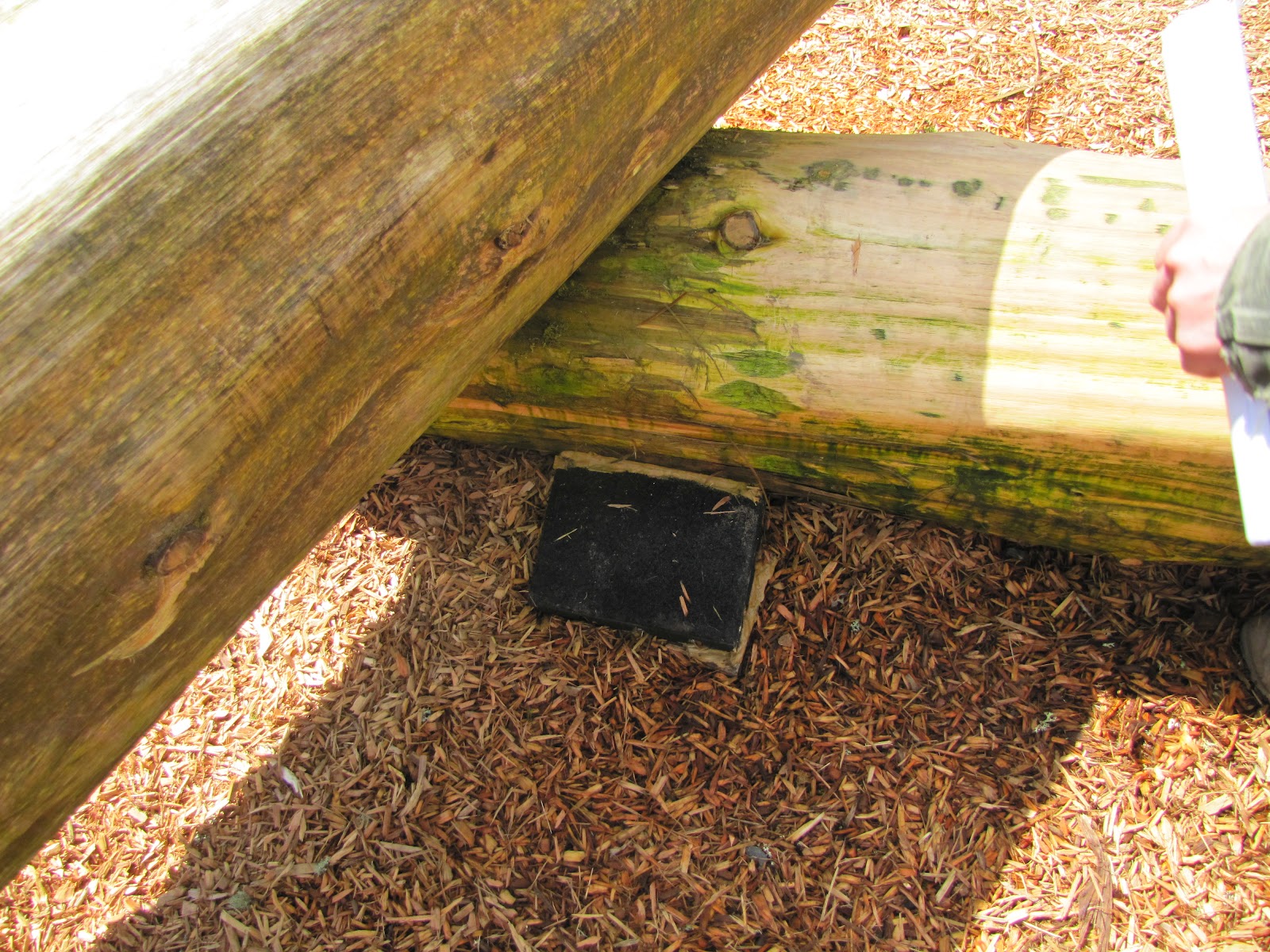
Logs are set on concrete footings and rebar adds support so they wont move around.
But these logs are huge! I can't image they will move for a long time.

Another view that I think is peaceful and beautiful especially compared to what a colorful climbing set would look like.

sand play

Thursday, June 07, 2012

Natural Play in Montessori Settings

I have been looking for a Montessori program for my little one and at the same time doing some landscape improvements at our house that will facilitate play. While she is a bit young for a slide or climbing equipment there are lots of things that are montessori based that she can do now. To me Montessori spaces are inviting in nature: they are inspiring, organized, and calm.

http://www.arborday.org
MARIA MONTESSORI
One of the central tenants of the Montessori philosophy is the connection with the natural world. Children should have the daily opportunity to experience the outdoors with structure and purpose. She placed a great emphasis on nature and nature education. Dr. Montessori also felt that the outdoor environment should be an extension of the classroom.


http://naturalplaygrounds.com

“It is also necessary for his psychical development to place the soul of the child in contact with creation, in order that he may lay up for himself treasure from the directly educating forces of living nature.” Maria Montessori


FACILITATING MONTESSORI WORK
Many of the ideas are not space based they are 'work' based. Much of Montessori education is based on prepared tasks or work that children can practice and achieve. How can Montessori work be adapted to outdoor spaces and materials? As a designer this leads to what types of spaces are needed? What materials are offered, where are they stored, and how?

Here is a basic Montessori math activity. We need exactly 55 pine cones (children check their work by using all the pieces) usually stored in a nice basket, chalk (also in the basket), a large, flat, and safe space where they can write and organize without being interrupted.


from http://livingmontessorinow.com
ORGANIZATION AND MATERIALS
Materials and spaces need to be organised so appropriate work can happen and so children are drawn to the work.


from http://progressiveearlychildhoodeducation.blogspot.com

APPROPRIATE OUTDOOR WORK
Much of the Montessori work for little ones happens around practical life skills. If only we can get kids to weed! At least digging, wheelbarrows, sweeping and planting seem to be within reach.


I could not find this web sourfce again after catching these littel ones at work. Please let me know if you know the source.


How do we inspire a deep and true connection to nature? I like this Montessori farm approach (dispite being bit by a chicken as a child)!

www.mountainlaurelmontessori.org

HOW TO MAINTAIN THE OUTDOOR MONTESSORI AREA
The process from inspiration to design can be a long and detailed endevour.  But, there are some wonderful resources out there. The Montessori Print Shop has learning materials as well as a specific section on playgrounds. They have a lot of helpful playground forms including an injury log, inspection forms for daily, monthly and yearly and seasonal maintenance. While the forms may seem like extra work they will be invaluable for maintenance, extending the life of your playscape, protecting children and liability.


Wednesday, January 11, 2012

Climbing High into A Nest :Creative Elevated Natural Play Structures

I am not sure what this is: a castle, a nest? But that makes it even more intriguing.

I love the giant cat tail forest and elevated nest!
I was recently turned onto KuKuK, a group of German designers that does wonderful play environment design. Their spaces make me want to work harder and push the envelope here in the US. They use a lot of wood logs, crazy wood nests, and netting tubes to keep kids from falling. Their work actually looks pretty safe while being extremely challenging and inviting! Unfortunately the website is in German, but like they say a photo is worth a thousand words.
Here is a different view of the same sight. It looks so organic it could have washed up on the shore all by self!
Beautiful giant swing
 From what I can gather from the website translation they are a group of artists, designers, and architects. Their work is obviously custom and their organization as a design build shop helps them carry the design intent through to construction.

You can climb through the ladder tube into the elevated nest then across the enclosed suspension bridge. I wonder how they attached this to the tree?

Tuesday, December 27, 2011

Forest School Short Film

No classroom for these school children: this documentary film takes us to a forest kindergarten in Switzerland where children age 4 to 7 spend every day outside in the forest. I wish I went to school here. I would love to find a place like this for my daughter.


http://vimeo.com/32463946

Tuesday, December 20, 2011

Whimsical Snake Breaks Through Playground!

This long green snake breaking through the tipsy tower and the maze of crooked balance beams must attract any young visitor at this ballet inspired playground.

The Danish company Hampus Playgrounds put together this magical piece containing:
- A large and small climbing wall
- 3 levels of play and climbing challenges
- Giant snake for climbing and balancing
- Climbing Rosk
- Balance Beams
- 3 sided climbing net
- Balance Ropes


Humpus Playgrounds has been making fascinating kids play equipment for 10 years. I like how their play approach is based in pedagogy and child development. They also highlight safe, cost effective, durable and sustainable playgrounds. Their promotional literature says

"Our design offers unusual shapes that challenge the mind and body. Our unique design and the search for innovative solutions has background in modern pedagogical and physiological knowledge. Children's physical, cognitive and creative development has the best conditions in diverse and varied environment close to nature's own idiom."


I am sure we will see more great design out of this Danish shop.
Related Posts Plugin for WordPress, Blogger...